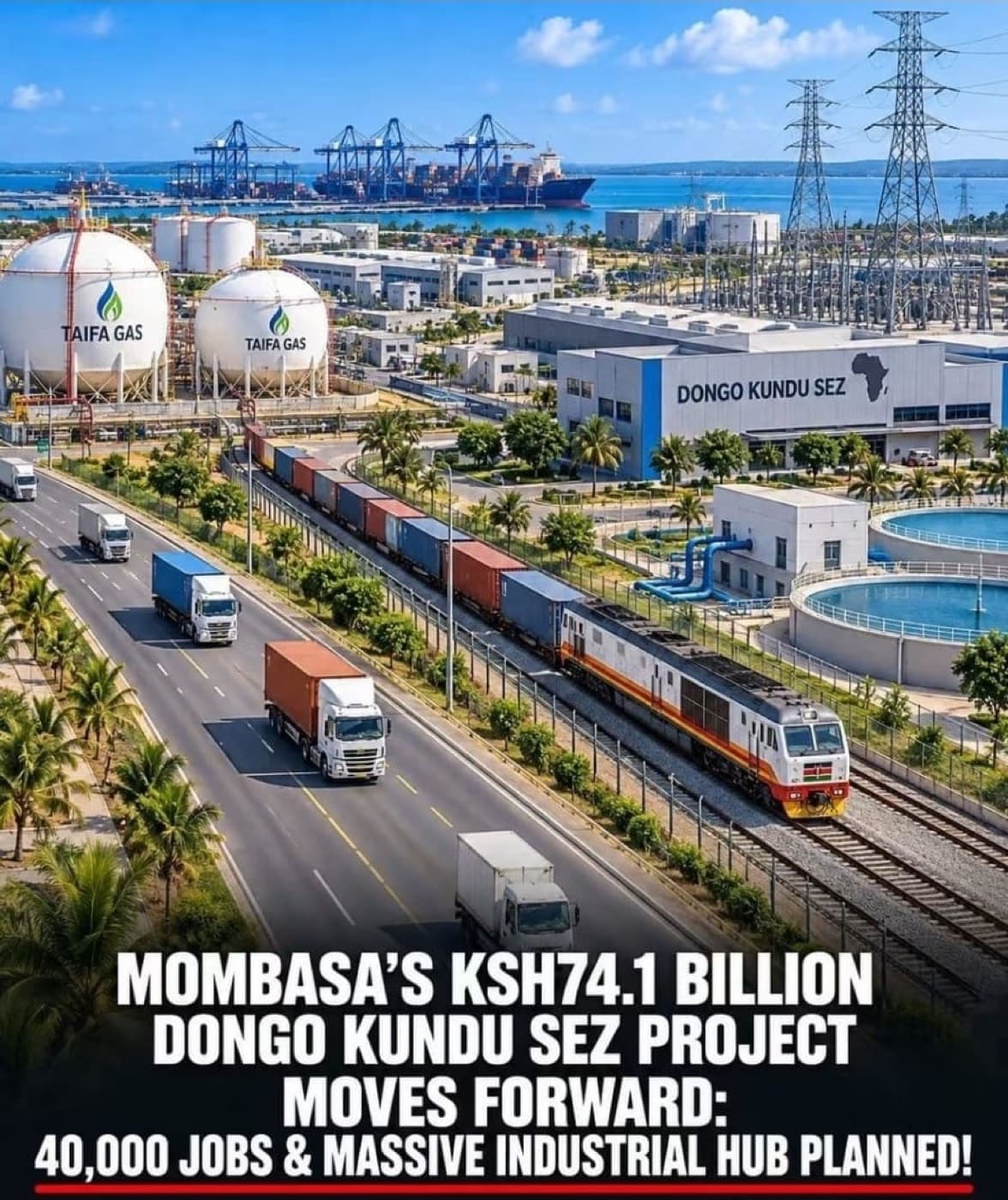
What the numbers, the timeline, and the honest gaps tell us about Kenya’s flagship coastal SEZ
Every time I drive past Likoni and catch a glimpse of the cranes and container stacks along the coastline, I think about how much of Mombasa’s future is being quietly assembled just south of the port most of us only ever see from the ferry. That’s Dongo Kundu, and after digging into what’s actually happening there in 2026, I think it deserves more attention than the flashy infographics circulating online are giving it.
Yes, the numbers are real: Ksh 74.1 billion earmarked, 40,000 jobs projected, a “massive industrial hub” in the making. But the fuller story, the one with both the momentum and the honest delays, is far more interesting than a single headline can capture.
What exactly is Dongo Kundu?
Strip away the branding and Dongo Kundu is, at its core, 3,000 acres of land in Likoni Sub-County that the government has set aside to become Kenya’s flagship Special Economic Zone. It sits immediately south of the Port of Mombasa, and its entire investment pitch rests on one word: connectivity.
Within a short radius, you have the Port of Mombasa itself, the Standard Gauge Railway, Moi International Airport, and both the Mombasa Southern Bypass and the newer Dongo Kundu Bypass. That’s sea, rail, air, and road access converging on a single site, something few industrial zones in East Africa can claim. The master plan, developed with backing from Japan’s international development agency, JICA, subdivides the zone into a Freeport Area, an Enterprise Area, Industrial Parks, a Free Trade Zone, and the utility infrastructure needed to run all of it.
The ambition has always been to turn Mombasa from a place goods simply pass through into a place where goods are actually made, pharmaceuticals, energy products, processed agricultural exports, all benefitting from preferential access to the African Continental Free Trade Area.
A project more than two decades in the making
Here’s something the glossy graphics rarely mention: Dongo Kundu isn’t a new idea. It was conceived well over twenty years ago, and for most of that time it existed mostly as a plan, Cabinet approvals, master plans, feasibility studies. The hard, unglamorous work of actually building it is a much more recent story.
The resettlement of people affected by the project had to be completed in phases before construction could even begin. Then came the tender for Berth One, Dongo Kundu’s flagship maritime access point, awarded to Japan’s Toa Corporation at a contract value of roughly ¥33.5 billion about Ksh 50 billion. In 2025, momentum picked up further with a $1 billion development lease agreement signed between the Kenya Ports Authority, the Special Economic Zones Authority, and Afreximbank, covering both Dongo Kundu and its sister zone in Naivasha.
By July 2026, Trade and Investment Cabinet Secretary Lee Kinyanjui was touring the site as new investors began formally committing. Today, in September 2026, construction of Berth One sits at roughly 16% complete, with full completion targeted for December 2028, and the entire zone isn’t expected to be fully operational until 2030.
I say all this not to dampen the excitement, but because a project this size deserves to be understood on a realistic timeline, not a headline’s timeline.
Following the Ksh 74.1 billion
So what does the money actually pay for? According to Transport Principal Secretary Mohamed Daghar, the Ksh 74.1 billion is specifically earmarked for the unglamorous but essential backbone of the zone: berths, roads, railways, power, water, and sewerage systems. This is the infrastructure that has to exist before any factory owner will commit capital to build on site, and its slow rollout has, until recently, been the single biggest obstacle holding Dongo Kundu back.
This allocation sits on top of the separate $1 billion lease agreement with Afreximbank, roughly Ksh 130 billion, which President William Ruto has said will help unlock more than 40,000 jobs at Dongo Kundu alone, alongside 100,000 more at the Naivasha SEZ. Berth One specifically carries a price tag of about Ksh 41 billion for its 300 metres of maritime frontage, with plans for seven additional berths to follow along the channel in later phases.
It’s a genuinely enormous public investment. Which makes the pace of private investment that follows it worth watching closely.
Who’s actually showing up?
Investor appetite, at least on paper, looks strong. The Kenya Ports Authority has received 97 applications for land allocation, covering close to 7,000 acres of interest across the wider zone, more land than the SEZ’s core 3,000 acres can even hold, a sign of how much demand exists on the margins. Afreximbank itself has secured 500 acres for an integrated industrial park, and the Transport PS has cited 94 separate investors expressing interest in setting up operations.
Two names stand out as concrete commitments rather than expressions of interest. Milly Glass SEZ Ltd, a subsidiary of the Milly Group, has committed to building what’s described as Africa’s first pharmaceutical glass bottle manufacturing plant on site, a genuinely significant addition given how much of East Africa’s pharmaceutical packaging is currently imported. And Ruike Energy Group Limited, a Chinese energy company, has expressed interest in establishing an oil refinery within the zone.
The incentive structure explains a lot of the appetite: SEZ enterprises enjoy a reduced corporate income tax of just 10% for their first ten years of operation, rising to 15% for the following decade, before settling at the standard 30% thereafter, plus duty-free treatment on qualifying imports and exports. For a manufacturer weighing where in East Africa to build, that’s a meaningful calculation.
The part most coverage skips: the honest gap
Here’s where I want to be straight with you, because I think it’s the most useful part of this story for anyone actually making decisions around Dongo Kundu, whether that’s a business considering land allocation, a law firm advising a client, or a SACCO thinking about coastal growth corridors.
More than two decades after it was first conceived, Dongo Kundu is still being held back by the slow rollout of the supporting infrastructure investors need before they’ll break ground at scale. The Ministry of Investments has acknowledged the delays outright. The World Bank has pointed specifically to land acquisition, compensation processes, and financing constraints as recurring bottlenecks, not one-off setbacks, but structural friction that keeps resurfacing.
A comparison that stuck with me: Tatu City, a privately developed economic zone near Nairobi, has moved considerably faster than Dongo Kundu, not because its vision is grander, but because it controlled its own serviced land and infrastructure timeline from the start. Publicly backed flagships like Dongo Kundu and Naivasha have made real, measurable progress on land preparation and investor commitments, but that progress hasn’t yet translated into large-scale manufacturing output on the ground.
To be fair to the project, analysts note this lag isn’t unique to Kenya. Shenzhen, Tangier Med in Morocco, and Ethiopia’s industrial parks all needed years of sustained investment before becoming globally competitive. Slow doesn’t necessarily mean stalled. But it does mean the “40,000 jobs” figure is a projection for a fully operational zone in 2030, not a count of jobs that exist today.
On costs, there has been genuine movement, government reduced electricity tariffs by Ksh 0.27 per kilowatt hour in June 2026, but manufacturers continue to argue that broader structural reforms are still needed if Kenya wants to compete head-to-head with regional industrial hubs for the same investors.
Why this matters beyond the headlines
If you’re based on the Coast, or working with clients who are, Dongo Kundu is worth tracking for reasons that go beyond the topline job numbers:
- It signals where growth is heading. A zone of this scale: spanning pharmaceuticals, energy, and manufacturing represents a genuine shift in what Mombasa’s economy could look like by the early 2030s, moving beyond its traditional role as a transit port.
- It will generate real downstream demand. Industrial activity at this scale doesn’t happen in isolation. It pulls in demand for legal advisory, compliance work, logistics services, property transactions, and financial products across Mombasa and into Kwale, the kind of ripple effect that reaches SACCOs, banks, and law firms long before a single factory opens its doors.
- Land and resettlement issues remain live. The compensation and land allocation processes tied to Dongo Kundu sit alongside the broader property law questions already unfolding along the coast leasehold dynamics, title transactions, and the kind of due diligence that becomes more, not less, important as large-scale investors start acquiring land nearby.
- The timeline matters for planning. Anyone building a strategy around Dongo Kundu, whether that’s a business, a law firm, or a financial institution needs to plan against 2028 (Berth One) and 2030 (full operation), not against the enthusiasm of a single announcement.
The bottom line
Dongo Kundu is not a mirage, and it’s not a project quietly failing either. It’s a genuinely large, genuinely underway piece of national infrastructure that has finally started moving after two decades of mostly being a plan on paper. The Ksh 74.1 billion is real money going toward real berths, roads, and power systems. The investors Milly Glass, Afreximbank, the dozens of applicants for land are real too.
What’s also real is the gap between announcement and delivery that has defined this project for most of its history. The honest version of this story isn’t “40,000 jobs are coming” or “the project is stalled.” It’s that Mombasa is watching a flagship industrial hub get built in real time, at a pace that’s finally picking up and the smart move, for anyone with a stake in the Coast’s economic future, is to track it closely rather than take either the hype or the skepticism at face value.
Sources: Office of the President of Kenya; Kenya News Agency/Kenya Tribune; The Standard; Jumuiya News; Capital FM Africa/allAfrica SEZ strategy analysis (July 2026); Freight Logistics Magazine; Mombasa Investment Corporation; The Coast Media Group. Reporting current to September 2026.