

Introduction
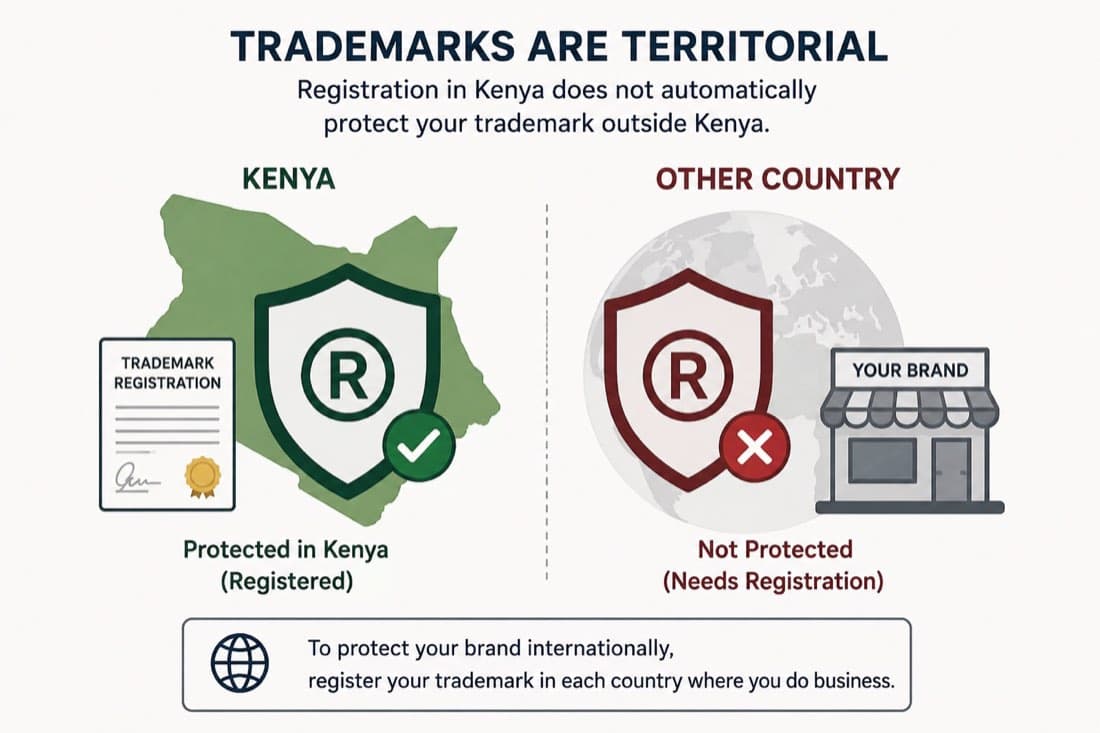
Trademark protection safeguards a business’s brand identity, reputation, and commercial goodwill. In Kenya, trademarks are governed by the Trademarks Act (Cap. 506) and administered by the Kenya Industrial Property Institute (KIPI). Registration of a trademark gives the proprietor exclusive legal rights over the use of the mark in relation to specified goods or services. However, registration in Kenya does not automatically extend protection outside Kenya because trademark rights are territorial in nature.
Principle of Territoriality
The principle of territoriality means that trademark rights are limited to the country where the trademark is registered. Under Section 7 of the Trademarks Act (Cap. 506), registration grants the proprietor exclusive rights to use the trademark within Kenya only. Therefore, a trademark registered in Kenya cannot automatically prevent another person from using or registering the same mark in another country unless protection has also been obtained there.
This principle was affirmed in Sony Corporation v Sony Holdings Limited where the court emphasized that trademarks are territorial and that a mark being well-known in another country does not automatically make it well-known or protected in Kenya. The court recognized that trademark rights must be determined according to the law and registration within the specific jurisdiction concerned.
Applicable Principles and Statutory Provisions
Section 14 of the Trademarks Act (Cap. 506) prohibits the registration of deceptive or scandalous marks. A trademark cannot be registered if its use is likely to deceive or confuse consumers, is contrary to law or morality, or contains scandalous matter. This provision protects consumers and ensures fairness in trade by preventing misleading representations in the market.
Section 15 of the Act prohibits registration of marks that are identical or nearly resemble an existing registered trademark in respect of the same goods or services. The purpose of this section is to prevent confusion among consumers and to protect the proprietary rights of existing trademark owners. However, the Registrar or court may allow registration in cases of honest concurrent use or where special circumstances exist.
Section 15A protects well-known trademarks. The section restrains the use or registration of marks that are identical or like a well-known trademark where such use is likely to cause confusion or unfairly take advantage of the reputation and distinctive character of the existing mark. This provision safeguards goodwill and prevents unfair competition.
The key legal principles applicable in trademark law are therefore:
- Territoriality – trademark protection is limited to the country of registration.
- Distinctiveness – a trademark must distinguish the goods or services of one trader from another.
- Prevention of Consumer Confusion – marks likely to deceive or confuse consumers cannot be registered.
- Protection of Goodwill – the law protects the reputation and commercial value attached to a trademark.
- Honest Concurrent Use – similar marks may in limited circumstances coexist where fairness and special circumstances justify registration.
Effect of Kenyan Registration Outside Kenya
Registration of a trademark in Kenya only grants protection within Kenya. A person in another country may lawfully register or use a similar mark if the Kenyan proprietor has not secured registration in that jurisdiction. As a result, Kenyan businesses intending to expand through exports, franchising, licensing, or e-commerce must seek trademark registration in the countries where they intend to operate.
Failure to secure international protection may expose a business to risks such as loss of brand identity, infringement disputes, and inability to enforce rights abroad. Trademark registration is therefore jurisdiction-specific, and enforcement depends on the laws of the country where protection is sought.
Conclusion
Registration of a trademark in Kenya does not automatically apply outside Kenya because trademark rights are territorial in nature. Under Sections 7, 14, 15, and 15A of the Trademarks Act (Cap. 506), Kenyan law protects distinctive trademarks, prevents consumer confusion, and safeguards business goodwill within Kenya. Kenyan courts have consistently upheld the principle of territoriality in trademark disputes. Consequently, businesses seeking protection beyond Kenya must obtain registration in the specific jurisdictions where they require protection.