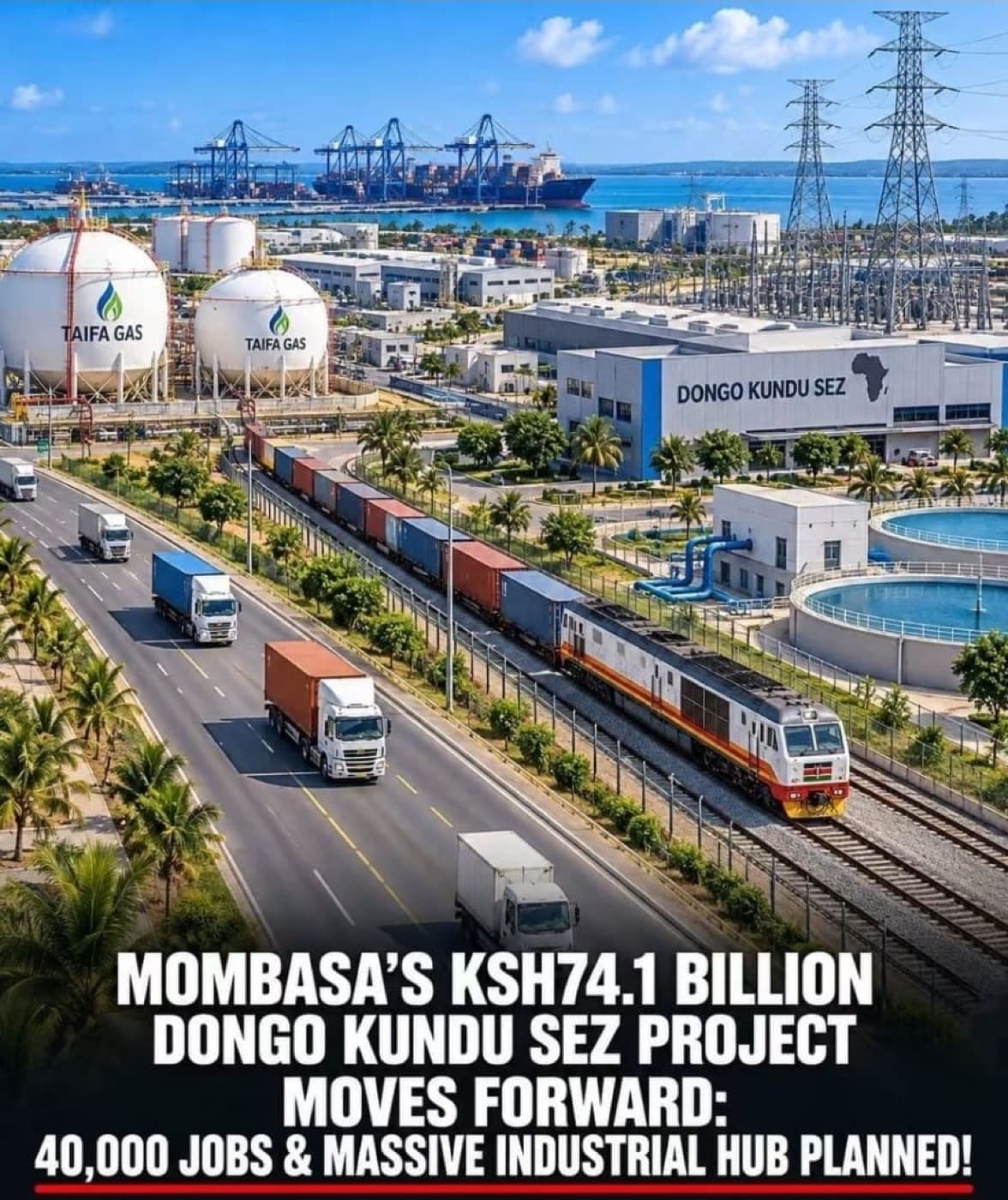

A Dubai logistics giant has just been licensed to build a second special economic zone a short distance from Kenya’s flagship one. What does that mean for Dongo Kundu?
When I first read that a UAE company had won the right to develop a special economic zone in Mombasa, my immediate question was the one everyone at the Coast is now asking: does this threaten Dongo Kundu, or does it help it?
First, a small but important correction on the facts. The company is DP World, the Dubai-based ports and logistics group, and the project was not a government tender award. It is a private partnership between DP World Africa, Mombasa businessman Suleiman Shahbal’s GulfCap Group and the Mombasa County Government, which supplies the land. The agreement was signed at State House, Nairobi, on 8 September 2026, with President Ruto presenting a developer’s licence to DP World’s chairman.
The short answer to the big question is this: the two zones are far more likely to complement each other than to destroy each other, but only if the government manages the overlap carefully. Let me explain why.
What was actually signed
The new zone, branded the Mombasa Industrial Park, sits in Jomvu on a site once used by the Kenya Meat Commission as a cattle holding ground. It covers about 535 acres, which is roughly 222 hectares, with an initial phase of about 40 hectares. The partners put the first-phase investment at more than Sh12 billion (over US$100 million) and say 67 companies have indicated they will take space. They are targeting pharmaceutical, engineering, manufacturing and agro-processing firms.
It is worth being careful here. DP World’s own project description says the deal remains subject to conditions precedent and formal documentation. In other words, the signing is a milestone, not the finish line.
Where Dongo Kundu stands
Dongo Kundu is the much larger, government-led project: about 3,000 acres in Likoni, managed by the Kenya Ports Authority. After more than two decades of planning, it is finally visibly moving. Construction of Berth One began in October 2025, and by September 2026 the Transport Ministry reported it was 16 per cent complete, with handover targeted for December 2028. The government has set aside Sh74.1 billion for the enabling infrastructure, and 94 investors have expressed interest, with four already building, including Taifa Gas, Milly Glass and Afreximbank.
But the honest picture also includes the slow parts. The access road to the port has been awarded but construction had not begun as of August, and industry voices have warned that a berth alone will not unlock a zone without power, water and internal roads. The full zone is not expected to be operating until around 2030.
Side by side
| Dongo Kundu SEZ | Mombasa (Jomvu) SEZ | |
| Location | Likoni, south of the Port of Mombasa | Jomvu, Mombasa, on a former Kenya Meat Commission holding ground |
| Size | About 3,000 acres | About 535 acres (222 hectares), first phase about 40 hectares |
| Developer | Government, through Kenya Ports Authority | DP World Africa and GulfCap Group (via Mombasa Free Zone Limited), with Mombasa County supplying land |
| Maritime link | Own berths: Berth One (300 m, about Sh41 billion), seven berths planned | No berth of its own; relies on the Port of Mombasa nearby |
| Status | Berth One about 16% complete, due December 2028; full operation around 2030 | Agreement signed 8 September 2026; subject to conditions precedent and formal documentation |
| Target tenants | Heavy and port-linked industry: LPG, glass, large-scale manufacturing | Pharmaceuticals, engineering, light manufacturing, agro-processing |
| Jobs projected | About 5,600 direct jobs | About 7,972 direct jobs in phase one (GulfCap estimate) |
The case that they complement each other
- Different products. Dongo Kundu is built around its own deep-water berths and large industrial plots, which suits bulk, heavy and port-dependent industries. Jomvu has no berth and is pitched at lighter manufacturing, pharmaceuticals and agro-processing that simply want to be near the port and the Standard Gauge Railway.
- Demand is bigger than supply. KPA has recorded 97 land applications covering nearly 7,000 acres, more than twice what Dongo Kundu’s core 3,000 acres can hold. A second zone can absorb investors who would otherwise be turned away or kept waiting.
- Speed fills a gap. Dongo Kundu’s berth is more than two years from completion. A privately funded zone that moves quickly can start building the supplier base, skills and cargo volumes that Dongo Kundu will later benefit from.
- A proof of concept. If a global operator like DP World can make an SEZ work in Mombasa, it strengthens the case for investing in the whole coastline, Dongo Kundu included.
- Shared logistics ecosystem. Analysts, including logistics commentators, argue that the best outcome is a cluster in which factories across both zones supply and buy from each other, feeding more cargo through the same port.
The case for competition
It would be naive to pretend there is no tension, and the history shows it. An earlier attempt to develop the Jomvu site failed after 18 of 19 interested firms dropped out, partly because they saw it as competing with the government’s Dongo Kundu plans. That the government has now blessed the project at the highest level suggests policy has shifted, but the commercial reality has not gone away.
- Competing for the same tenants. Both zones will court manufacturers and exporters. An investor who needs land now may well choose Jomvu over waiting for Dongo Kundu’s infrastructure.
- Incentives and cost. Dongo Kundu has offered attractive electricity pricing and SEZ tax treatment. If Jomvu offers comparable benefits with faster delivery, the public zone could be left with a weaker pitch.
- Oversupply risk. If both zones chase the same limited pool of tenants without enough demand or supporting infrastructure, Mombasa could end up with more industrial land than investors.
- DP World’s wider strategy. DP World spent years seeking a concession to run berths at the Port of Mombasa, an effort that ended in controversy and a settled court case in 2024. One analyst quoted by EnterpriseAM noted that an industrial zone gives the company a stake in Mombasa’s cargo flows without needing to control the terminal. That is smart business for DP World, but the national interest and the company’s interest will not always point the same way.
Where the risk really sits: delivery
In my view, the competition question is secondary to the delivery question. Investors judge a zone on reliable power, water, roads and quick customs clearance, not on glossy brochures. This is where Dongo Kundu has struggled, and where Jomvu will be tested too. At the signing, the President reportedly gave a six-month target for the zone and 120 days for a one-kilometre access road, deadlines that will quickly show whether the private model delivers faster than the public one.
There is also a legal and governance dimension that lawyers and students of the Special Economic Zones Act should watch. Kenya’s SEZ framework allows public, private and public-private zones, with developers licensed and regulated by the SEZ Authority. That means the two zones will sit under the same rulebook but with very different owners and incentives. Transparency on licence terms, land tenure (Dongo Kundu’s resettlement of more than 1,600 people was a long-running obstacle) and how incentives are applied will decide whether investors see a level playing field.
So, complement or compete?
My honest reading is that they will do both, and the balance depends on policy choices still to be made. Left unmanaged, two zones in the same small corner of Mombasa could fight over the same tenants and leave the public zone, with its heavy infrastructure bill, as the loser. Managed well, with Dongo Kundu positioned for port-dependent heavy industry and Jomvu for lighter, fast-moving manufacturing, the combined effect could be a real industrial belt around Africa’s busiest gateway on the eastern seaboard.
For the people of the Coast, the measure of success is not how many acres are gazetted. It is how many factories are humming, how many young people are employed, and how much of what leaves Mombasa is finished goods rather than raw materials. On that test, a second zone is good news, provided it pulls in the same direction as the first.
What to watch next
- Whether the Jomvu partners meet their stated six-month and 120-day timelines.
- Who the first tenants are, and whether they are manufacturers or mainly warehousing and distribution firms.
- Progress on Dongo Kundu’s port access road and utilities, and Berth One’s march toward December 2028.
- Any government guidance on how the two zones’ incentives and tenant targeting will be coordinated.
Sources and notes
Information is drawn from published reports to 18 October 2026 and may change as the project documents are finalised. Figures for the Jomvu zone vary slightly between sources (535 acres and 222 hectares are used interchangeably) and job numbers are developer estimates.
- Daily Nation, “DP World’s bets on Sh12bn Mombasa industrial park” (9 September 2026)
- DP World / UAE Media Office, agreement announcement for the 222-hectare Mombasa Industrial Park (9 September 2026)
- The Standard, “How DP World SEZ deal will boost Mombasa’s economy”
- The Africa Logistics, “DP World’s Mombasa SEZ: Why the Port’s Next Opportunity May Be Beyond the Terminal” (9 August 2026)
- EnterpriseAM, “DP World to build special economic zone in Kenya” (5 August 2026)
- Billionaires.Africa, report on the GulfCap and DP World signing (9 September 2026)
- Kenya Engineer, “Dongo Kundu: Building Kenya’s new industrial and logistics gateway” (3 October 2026)
- Ministry of Transport, “Dongo Kundu SEZ Moves Closer to Unlocking Its Economic Potential”
- Kenya Tribune and Jumuiya, reports on the Sh74.1 billion allocation and Berth One progress
- The Standard, “Slow infrastructure rollout stalls Dongo Kundu SEZ dream”
- Capital FM, “Inside Kenya’s SEZ strategy: Are Dongo Kundu, Naivasha and Tatu City delivering?”
- Daily Maverick, “Zoning in” (15 October 2026)