
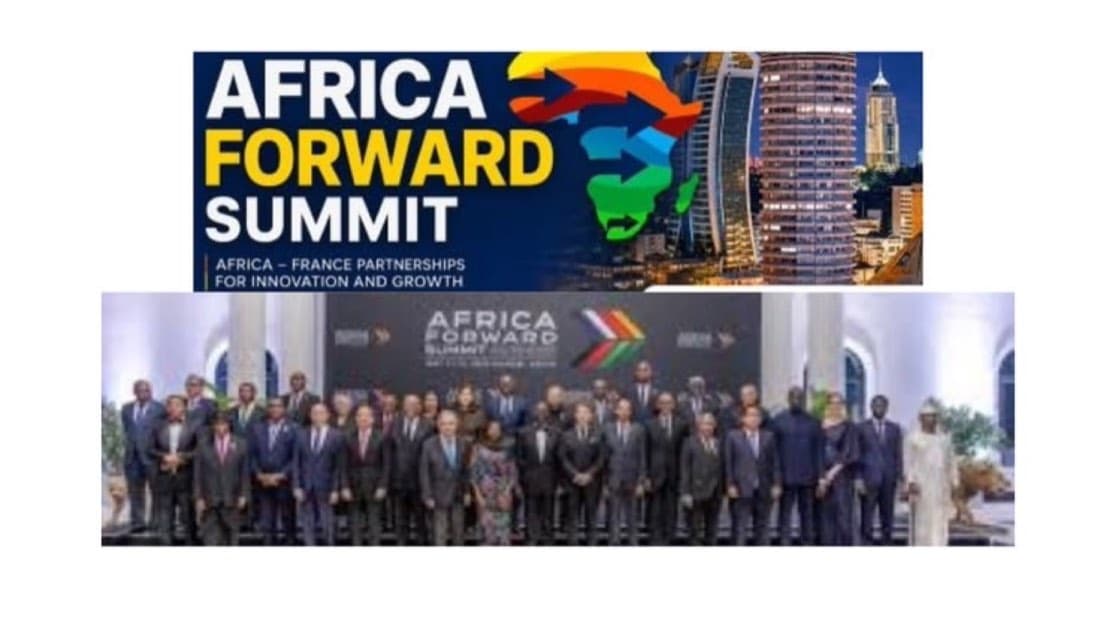
Nairobi hosted a landmark France-Africa summit that brought significant investment commitments, a deepened bilateral relationship, and a set of legal and commercial questions that deserve careful reading.
On May 11 and 12, 2026, Nairobi became the first city outside the Francophone world to host a France-Africa summit. The Africa Forward Summit, officially titled “Africa–France Partnerships for Innovation and Growth,” brought together more than thirty heads of state, over 2,000 private-sector delegates, and the leadership of major multilateral institutions, all convening under the co-chairmanship of President William Ruto and French President Emmanuel Macron. The venue was the Kenyatta International Convention Centre. The agenda was ambitious: green industrialisation, artificial intelligence and digital infrastructure, blue economy, health, agriculture, peace and security, and reform of the international financial architecture.
For Kenya, hosting this summit was neither accidental nor passive. It was the product of deliberate diplomatic positioning over several years. What it signals for the bilateral relationship, for the investment environment, and for the legal and governance questions that accompany large-scale foreign engagement, is worth examining carefully.
What the Summit Is, and Why It Matters
France has convened Africa-France summits since the 1970s, historically held in Francophone countries and closely associated with what became known as Françafrique: the web of political, military, and economic relationships through which Paris maintained influence over its former colonies after independence. Those relationships, whatever their commercial benefits, were never fully equal, and France’s standing in parts of West and Central Africa has deteriorated significantly in recent years, following military coups and the expulsion of French forces from Mali, Burkina Faso, and Niger.
The decision to hold the 2026 summit in an English-speaking, non-Francophone country is itself a statement of intent. Macron has been publicly working since 2017 to reframe France’s Africa policy, acknowledging elements of the colonial past and articulating a relationship built on what he described at the summit as a “partnership of equals.” Choosing Nairobi signals that France is seeking to broaden its African engagement beyond the traditional Francophone sphere, and that Kenya, as the region’s largest economy and a diplomatically active state, is seen as the natural anchor for that pivot.
Academic commentary in The Conversation observed that the alignment between the two governments runs deeper than protocol. Both Macron and Ruto have emphasised private-sector-led development, climate finance, and reform of international financial institutions. The summit’s seven thematic pillars were not assembled by committee: they reflect a shared agenda that has been building through bilateral conversations since at least 2020.
Kenya and France: The History of the Relationship
Kenya and France have no colonial relationship. Kenya was British. That absence of colonial history is part of what makes the bilateral relationship relatively uncomplicated compared with France’s engagements in West Africa, and part of why Nairobi is an attractive venue for a summit intended to signal a new beginning.
The relationship traces back at least to September 1970, when France sent a legal expert to advise Kenya’s Ministry of Industry and Commerce on the then-newly formed East African Community, and sought cooperation with the East African Development Bank. Over subsequent decades the economic relationship grew steadily.
By 2020, French business investments in Kenya had exceeded one trillion Kenyan shillings, concentrated in roads, energy, food, health, and technology. As of 2026, at least 140 French companies operate in Kenya, up from 40 in 2013. France is the fifth-largest provider of foreign direct investment in Kenya, supporting approximately 46,000 direct jobs. TotalEnergies, Orange, CMA CGM, Schneider Electric, Air France, and BNP Paribas all have a material presence here. Kenya is, in turn, the largest customer of French products within the East African Community.
The political relationship has been active. President Kenyatta visited Paris in 2020, signing bilateral agreements on the Nairobi-Nakuru-Mau Summit highway, JKIA infrastructure, and energy transmission. That highway project was subsequently terminated in 2025, when the Ruto administration concluded that the terms with the Vinci SA-led consortium placed disproportionate risk on the Kenyan side and awarded the contract instead to Chinese firms. The episode is a useful reminder that commercial relationships, however diplomatically warm, are subject to renegotiation when their terms are found wanting.
“We should no longer think in terms of aid and loans, but rather in terms of investment and what Africa has to offer.” — President Ruto, Africa Forward Summit, May 2026
The Investments: What Was Announced and What It Signals
The headline commitment from the summit was €23 billion ($27 billion) in investment, comprising €14 billion from French public and private funds and €9 billion from African investors and entrepreneurs, directed at energy transition, agriculture, and artificial intelligence. Macron projected that the combined package would create 250,000 jobs across France and Africa.
The most concrete Kenya-specific announcement was from French shipping group CMA CGM, which committed €700 million ($820 million) toward the modernisation of a terminal at the Port of Mombasa. The timing is notable: Mombasa is simultaneously the subject of Dangote’s proposed refinery discussions and the principal gateway for Kenya’s fuel imports. The convergence of significant infrastructure capital at the coast in a short period reflects the port city’s growing strategic centrality to East Africa’s economic geography.
Alongside this, Schneider Electric announced a €120 million micro-grid plant near Mombasa, targeting a genuine gap in Kenya’s power distribution infrastructure. A bilateral agreement on digital infrastructure and connectivity was signed on the summit’s sidelines, along with a KSh 12.5 billion Nairobi Commuter Rail modernisation commitment. The defence cooperation agreement, signed in October 2025 and ratified by Kenya’s parliament in April 2026, provided the formal security architecture within which the summit took place.
Investors and advisers should read the €23 billion headline alongside its context. As Billionaires.Africa reported, the commitments are substantially private sector pledges rather than sovereign disbursements: France’s official development assistance budget has been cut five times in under two years, with appropriations for 2026 falling 18% from the prior year. Private capital follows commercial returns. The execution of these commitments will depend on the stability of Kenya’s regulatory environment, local content frameworks, and the degree to which deal terms are negotiated on genuinely equal footing.
The Questions the Summit Has Raised
A summit of this scale and geopolitical weight will naturally generate debate, and it has. The substantive questions being raised, by civil society, legal commentators, and foreign policy analysts, are worth understanding rather than dismissing. They are, in many cases, the same questions that practitioners advising on cross-border investment and public-private partnerships would ask of any large-scale foreign engagement.
On the defence cooperation agreement: The Kenya-France Defence Cooperation Agreement, ratified by parliament in April 2026, covers maritime security, intelligence sharing, peacekeeping, and humanitarian assistance. Kenya’s defence committee chair, Nelson Koech, has stated publicly that the agreement does not grant blanket immunity to French forces and that crimes such as murder remain subject to Kenyan jurisdiction. Nevertheless, the agreement does provide French forces primary jurisdiction over on-duty offences, with sentences potentially served outside Kenya. Commentators at Responsible Statecraft and The Hill have noted that similar jurisdictional arrangements in Kenya’s agreement with the United Kingdom have historically created accountability gaps. Professor Evans Ogada of international law observed that “uneven treaties present the perennial challenge for Kenya and Africa in general.” These are legitimate legal questions that bear directly on how such agreements are drafted, interpreted, and enforced.
On the sequencing of military and parliamentary processes: Approximately 800 French troops arrived in Kenya in March 2026 for joint exercises with the Kenya Defence Forces, ahead of the formal parliamentary ratification of the defence agreement in April. The Standard Media and Al Jazeera both noted this sequencing. From a constitutional and administrative law perspective, the order in which military deployments precede their governing legal instruments is a matter that deserves scrutiny in any jurisdiction, not as a political charge but as a governance observation.
On the investment terms and local content: The digital cooperation agreement and the broader AI and technology thematic of the summit sit alongside documented concerns about the terms on which Kenyan digital workers participate in the global technology economy. The Daily Nation noted existing friction over the use of Kenyan labour for low-value data annotation work for foreign technology companies. For the digital agreement to deliver the kind of value that its framing promises, local content provisions, technology transfer obligations, and fair compensation structures will need to be embedded in the implementing arrangements, not left to market forces.
On the breadth of domestic opinion: A coalition of civil society organisations, convening under the banner of the Pan-Africanism Summit Against Imperialism (PASAI), organised a counter-summit at Ufungamano House during the same two days, drawing activists and commentators who characterised the summit as a continuation of extractive foreign engagement rather than a genuine reset. Sixteen people were detained during a subsequent march. Whatever one’s assessment of the counter-summit’s characterisation of events, the breadth of organised domestic opinion on a bilateral partnership of this scale is itself information. Durable investment relationships tend to be more resilient where they carry broader public legitimacy.
“Africa is no longer content with aspiration alone. We are advancing with clarity and resolve, shifting from dialogue to delivery.” — Africa Forward Summit Concept Note, May 2026
How Analysts and Commentators Have Read the Summit
The assessment in the financial and foreign policy press has been thoughtful and genuinely divided.
On the constructive side, Al Jazeera’s detailed feature “Risks and Rewards in France-Kenya Partnership” noted that France’s naval capabilities and intelligence-sharing capacity meaningfully complement Kenya’s counterterrorism posture. Patricia Rodrigues, Africa Director at Control Risks, described the defence engagement as advantageous given the al-Shabaab threat environment. The Serrari Group assessed the CMA CGM and Schneider Electric commitments as hard infrastructure with genuine supply-chain and employment implications. UN Secretary-General António Guterres, speaking at the summit, used the platform to argue for African credit rating reform, observing that Africa’s borrowing costs, roughly twice those of advanced economies, are “a verdict on the injustices of the system, not on Africa.” If Macron’s proposed first-loss guarantee mechanism gains traction at the G7, Kenyan sovereign borrowing costs could shift meaningfully.
On the cautionary side, The Conversation observed that surface alignment on climate and AI between France and Kenya may obscure substantive divergence: France and the EU have been loosening emissions standards in response to the current energy environment, while Kenya faces the direct consequences of climate change in the form of extended droughts. Academic commentary from Responsible Statecraft noted that the language of mutual partnership tends to obscure structural asymmetries that only become visible in the implementing detail. The Capital FM analysis framed Kenya as France’s strategic pivot point following the Sahel losses, and raised the question of whether that positioning serves Kenyan interests over the long term or primarily French ones.
The Standard Media captured a domestic concern that runs through much of the commentary: the summit’s announced benefits, measured in aggregate investment figures and job creation projections, do not yet specify who bears the risk when private sector commitments are not met, which Kenyan communities and industries will be prioritised in implementation, and what enforcement mechanisms exist if the terms of cooperation agreements prove unbalanced in practice. These are implementation questions, not objections to partnership in principle, and they are precisely the questions that good legal and commercial advice is designed to address.
What This Means for Kenya in the Years Ahead
Taken together, the summit’s outcomes point toward a more structured and more visible French commercial and security presence in Kenya than has existed before. The question is not whether that engagement brings value, because it plainly can, but on what terms it is structured and how those terms are monitored over time.
The upside is material. The CMA CGM terminal investment, if delivered on the announced timeline, would upgrade Mombasa’s infrastructure at precisely the moment the port is competing with Dar es Salaam for regional pre-eminence and attracting parallel attention from Dangote’s refinery proposal. The Schneider Electric micro-grid addresses a real gap. The digital agreement, properly implemented, could position Kenyan technology talent at higher value points in the global AI supply chain rather than at the low end. And the credit rating reform agenda, if it advances at the G7, has systemic implications for every Kenyan borrower, public and private.
The areas requiring ongoing attention are equally clear. Private sector pledges are not sovereign guarantees: the Vinci highway cancellation illustrates how French corporate commitments can be restructured when commercial conditions change. The defence agreement’s jurisdictional provisions warrant precise legal analysis as they are operationalised. The visa reciprocity asymmetry, under which French nationals enter Kenya without a visa while Kenyan citizens face restrictions on entry to France, is a minor administrative irritant by one reading and a precise barometer of the relationship’s actual equality by another. And the breadth of domestic scepticism about the summit is a variable that will shape how effectively its commitments can be implemented at community level.
France’s choice of Kenya reflects a considered geopolitical calculation. Kenya’s choice to co-host reflects an equally considered one. The Africa Forward Summit has set a framework. Whether it becomes a genuinely transformational chapter in the bilateral relationship, or a well-produced diplomatic event that generates limited durable change, will be determined not by the declarations signed at KICC but by the contracts, implementing regulations, and accountability mechanisms negotiated in the months that follow.
The Bottom Line
This is a significant bilateral moment for Kenya, and it deserves to be read as one. The investments announced are the largest single tranche of French commitment to an East African partner in recent memory. The defence partnership adds a new dimension to Kenya’s security architecture. The digital and climate cooperation frameworks, if well-designed, could contribute to the kind of structural economic diversification Kenya has been seeking for a decade.
At the same time, the value of any partnership is ultimately determined by its terms, not its announcements. The legal frameworks governing the defence agreement, the local content and technology transfer provisions in the digital cooperation deal, the structure of the CMA CGM port concession, and the conditions attached to the clean energy investments will all require careful scrutiny as they move from summit commitments to executed agreements. That is not scepticism about the partnership. It is what responsible engagement with a relationship of this scale and complexity looks like.
Kenya has positioned itself as the continent’s most open and capable partner for exactly this kind of high-level engagement. Delivering on that positioning requires not just the diplomatic confidence to host, but the institutional and legal sophistication to negotiate the implementing detail on terms that serve the long-term national interest.
“We are not simply here to come and invest on the African continent alongside you — we need great African business leaders to come and invest in France.” — Emmanuel Macron, Africa Forward Summit, May 2026
CC. Kasichana Mumba
FURTHER READING
Official Africa Forward Summit website: africaforwardsummit.go.ke
Al Jazeera: Risks and Rewards in France-Kenya Partnership
Al Jazeera: Macron announces $27bn investment at Kenya summit
The Conversation: Why Nairobi summit bears the hallmarks of Macron and Ruto priorities
Responsible Statecraft: Spurned by Sahel, France courts Kenya
Standard Media: Civil society groups and the Africa-France summit
Capital FM Analysis: How Kenya became France’s Plan B
Billionaires.Africa: France’s €23bn Africa investment package in context
The Hill (AP): France woos Anglophone Africa at a summit in Kenya
France 24: Africa Forward Summit Day 2People’s Dispatch: Kenyan civil society mobilises around the summit